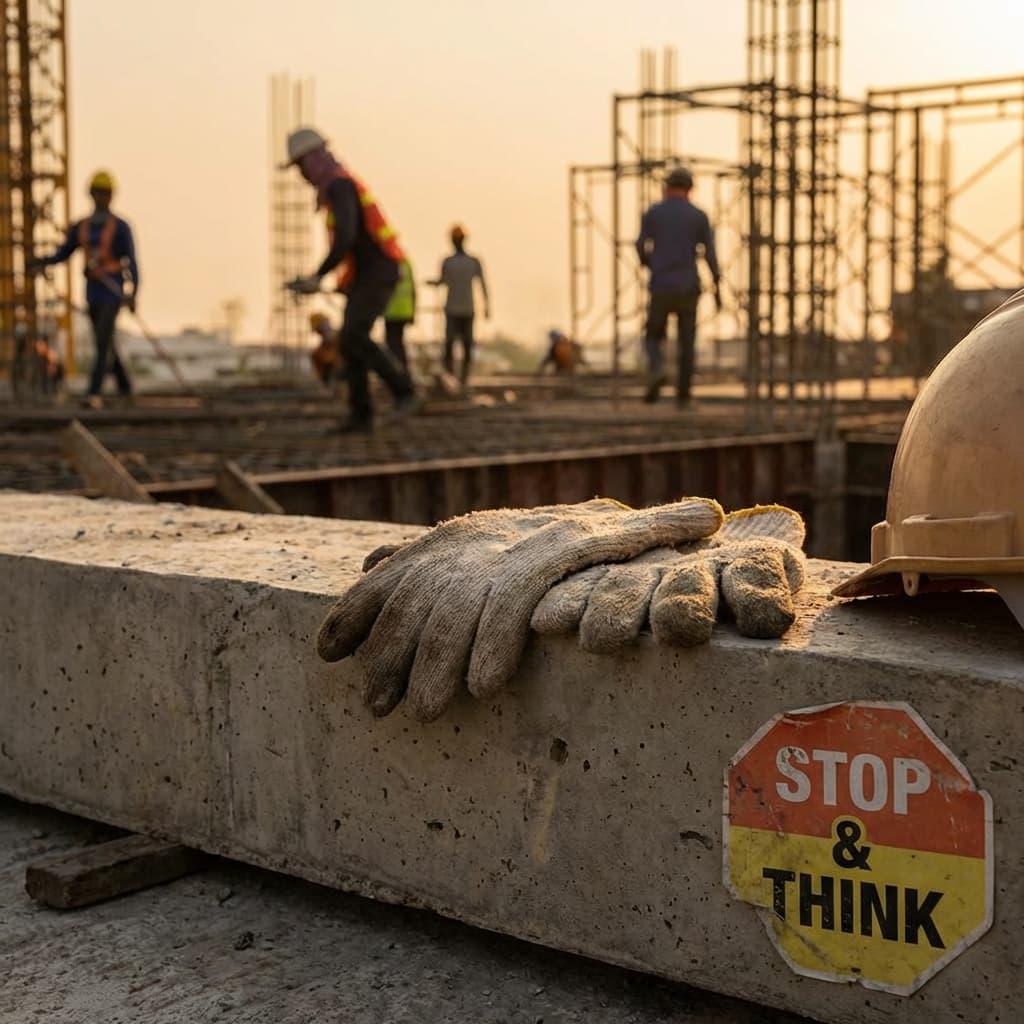
Complacency on Construction Sites: Best Practices for Prevention
Complacency on Construction Sites: Best Practices for Prevention
Complacency kills. In 2022, the Association of Workers' Compensation Boards of Canada reported that the construction industry experienced 183 fatalities across the country. The problem is not that workers don't care. The problem is that our brains are wired to conserve energy and recognize patterns, which creates a false sense of security over time.
It can happen on any project. A worker with 25 years of experience walks past the same hazard every day without incident. Then one day, something changes in the environment, and they don't notice. That's when people get hurt.
Understanding the Real Problem
Complacency is not simply a choice. It's also a biological tendency. Our cognitive processes are designed to recognize patterns and conserve mental energy. When workers engage in the same activities without negative consequences, they develop a false sense of security. The brain literally reinforces this through a principle neuroscientists call Hebbian learning: neurons that fire together, wire together. Each time a worker completes a task without incident, their brain strengthens the neural pathway that associates that behavior with safety, progressively reducing their perception of risk.
The construction environment makes this worse. Things change constantly. The environment you work in today is completely different from yesterday. Despite this reality, workers still become complacent. Inspections fail to happen. Workers walk or move equipment without looking where they're going. From a safety standpoint, they seem to be sleepwalking through the job.
A study published in Safety Science found that experienced workers were faster but not more accurate at identifying hazards compared to novice workers. The famous justification of "I've been doing it this way for 25 years and nothing bad has ever happened" represents the most dangerous cognitive blind spot on a construction site.
1. Train Hazard Recognition as a Skill
Hazard recognition is not something workers automatically develop through experience. It's a trainable skill. Studies show that failure in hazard identification is often due to limited or improper training and supervision.
You need to invest in direct training at the execution layer. Workers must be trained to identify hazards under real conditions with compressed time, production pressure, and incomplete information. Training cannot be a one-time event. It must be continuous and reinforced through daily interactions.
Training must focus on energy-based hazards and develop the decision-making competence to stop work when something doesn't look right. This training needs to happen on the ground, not just in a classroom.
2. Empower Frontline Supervisors to Enforce Standards
Frontline supervisors hold the program together. They coach hazard recognition, enforce standards without compromise, and intervene in unsafe acts before incidents happen. Without trained supervisors who have the authority to stop work, your prevention program is just documentation.
Supervisors need clear authority and backing from management. They must be able to enforce protocols even when it conflicts with production pressure. Accountability without authority creates the exact conditions where complacency thrives. Workers see that shortcuts are tolerated, and they adjust their behavior accordingly.
The optimal span of control is 8-12 direct reports. Beyond that, supervisors cannot maintain effective oversight. They miss the small deviations that signal growing complacency. Keep your supervisory ratios tight and invest in their training.
3. Conduct Daily Field-Level Risk Assessments
Daily field-level risk assessments force workers to actively engage with their environment. They cannot sleepwalk through a task if they must identify hazards before starting work. This practice breaks the pattern recognition loop that creates complacency.
The key is consistency. FLRAs must happen every day, for every task, without exception. When you skip them because "we've done this a hundred times," you've already lost. That's the moment complacency takes over.
Supervisors must review these assessments and use them as coaching opportunities. If a worker misses an obvious hazard during the assessment, that's a training gap you need to address immediately.
4. Create a Stop-Work Culture
Workers must have the authority and training to stop work when they identify a hazard or when something changes. This authority means nothing if workers fear retaliation or if production pressure overrides safety concerns.
Stop-work authority often exists on paper but not in practice. Workers know that stopping work creates friction with supervisors or delays the schedule. They make the calculation that it's easier to proceed than to speak up. That's when incidents happen.
You need to demonstrate that stop-work authority is real. When a worker stops work, management must respond with support, not frustration. Investigate the concern, address the hazard, and thank the worker for speaking up. Do this consistently, and you'll build a culture where workers feel empowered to act.
5. Address Complacency Through Behavioral Observation
Behavioral observation programs identify complacent behaviors before they result in incidents. Supervisors and safety personnel observe workers performing tasks and provide immediate feedback when they see shortcuts or protocol deviations.
The goal is not to punish workers. The goal is to understand why the deviation happened and correct it through coaching. Often, you'll find that workers don't fully understand the protocol, or they've developed workarounds because the official process is impractical under real conditions.
These observations must be frequent and consistent. Complacency develops gradually. You need to catch it early through regular observation and intervention.
6. Rotate Tasks and Introduce Variability
Repetition breeds complacency. When workers perform the same task in the same way every day, their brains shift into autopilot. Introducing variability forces them to stay engaged.
Rotate workers through different tasks when possible. Change the sequence of operations. Introduce new equipment or methods periodically. These changes disrupt the pattern recognition that leads to complacency.
This doesn't mean creating chaos. It means preventing the monotony that allows workers to disengage mentally while performing high-risk tasks.
7. Investigate Near-Misses as Seriously as Incidents
Near-misses are warnings. They show you where complacency has taken hold before someone gets hurt. If you ignore near-misses or treat them as minor issues, you're missing the opportunity to prevent serious incidents.
Investigate every near-miss. Identify the contributing factors. Was it a training gap? A procedural issue? A supervisor who didn't intervene? Use that information to adjust your prevention program.
Workers need to see that reporting near-misses leads to real changes. If they report a near-miss and nothing happens, they'll stop reporting. Then you lose visibility into where complacency is growing.
The Bottom Line
With proper planning, construction incidents are preventable. Complacency is not inevitable. It's a predictable result of how our brains function under routine conditions. You can prevent it through direct training, supervisor empowerment, consistent enforcement, and behavioral observation.
Policies and programs provide the framework, but they don't prevent incidents on their own. Prevention happens through trained workers and supervisors who enforce standards under real conditions. That's where you need to invest your time and resources.
What do you think? Which of these practices is missing on your site?