Your Brain Isn't Built for This
Your Brain Isn't Built for This
Safety work is more information-dense than most people outside the industry realize. Regulatory updates, revised standards, incident data, lessons learned, training content, and industry research all compete for the same limited mental bandwidth you need to do the actual work. Working memory itself is limited; research commonly places its core capacity at only a few meaningful items at a time.
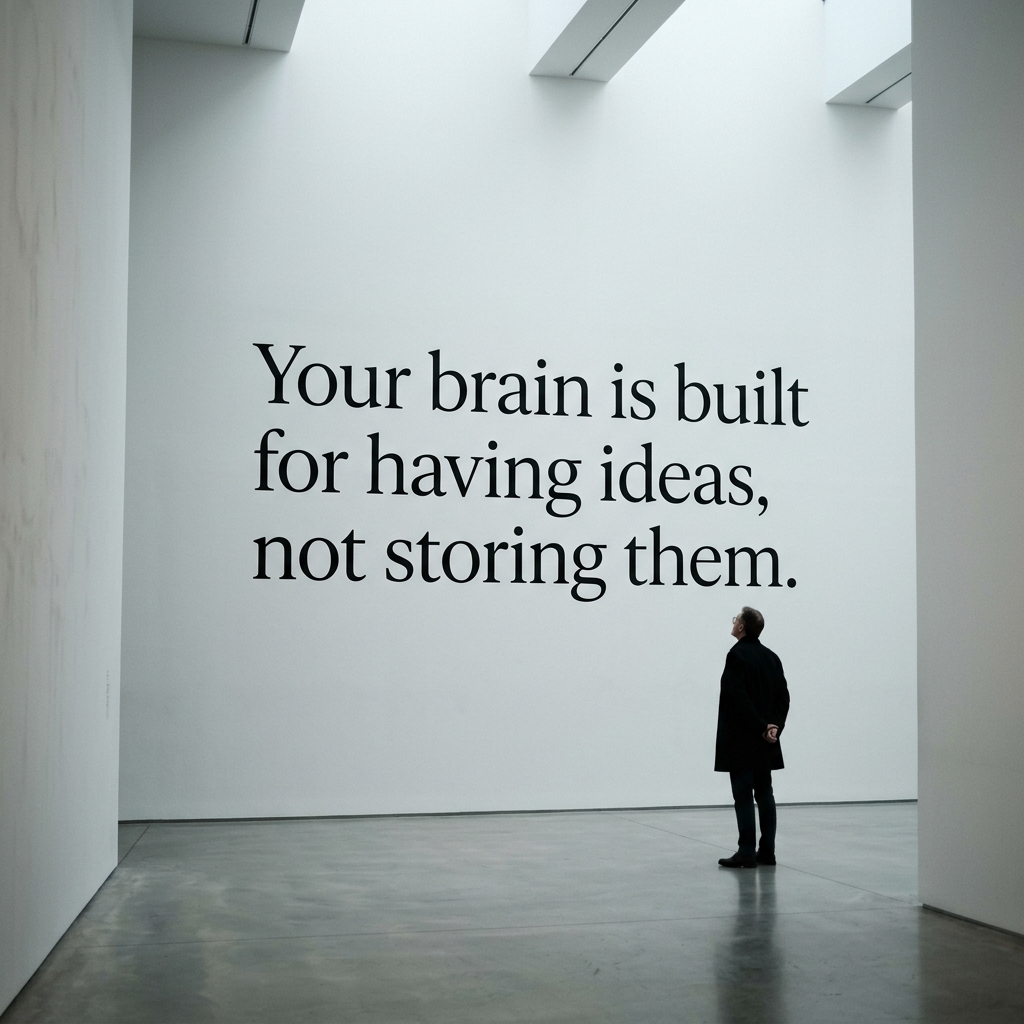
That's the problem. Your brain is built for having ideas, not storing them. When you're trying to remember everything, you're using mental capacity that could be focused on recognizing hazards, coaching supervisors, and making decisions that prevent harm.
The natural response is to try managing it all through discipline and better organization. But that often doesn't solve the problem. The information keeps piling up, and you can start defaulting to habit instead of actually thinking through what the situation requires. That's when you might need a second brain.
What Is a Second Brain?
A second brain is an external system for capturing and organizing everything your mind processes but can't reliably hold onto. Your biological brain is where thinking happens. Your second brain is where knowledge lives so you can retrieve it when you actually need it.
The key distinction from a notebook or filing cabinet: a second brain doesn't just store information, it connects it. Information in isolation is just data. Knowledge happens when you can see how pieces relate. How the confined space regulation you saved last month connects to the updated procedure from a recent training session, which connects to the toolbox talk you delivered six weeks ago. That's what changes how you work.
What a Second Brain Actually Does
A second brain helps solve the categorization problem. Traditional tools and storage methods like Notion, Evernote, or thumb drives full of PDFs can become difficult to maintain because they often depend on you organizing information at exactly the wrong moment: when you're busy, tired, or just trying to capture something fast. You end up with a junk drawer you stop trusting, and eventually stop using.
A well-designed second brain removes much of that friction. When you save something, the system handles the organization. When you need something, you ask for it conversationally, not hunt through folders. The information you've already validated as valuable can surface in seconds, connected to other relevant material in your knowledge base.
For safety professionals, this is the difference between a static archive and an active thinking tool. It's not where documents go to die. It's where the right information finds you when you're coaching a supervisor on confined space entry, reviewing a procedure, or building a toolbox talk at 6 AM before the crew shows up.
The Cognitive Load Problem
Occupational health and safety is knowledge-intensive work. Safety practitioners can work across multiple provinces, each with different laws and standards, across numerous industry sectors, with companies managing multiple trades. In that environment, a second brain can start to feel less like a productivity tool and more like a necessity.
Cognitive overload happens when your working memory receives more information than it can handle. In high-hazard industries, that overload can impair judgment, lead to missed warning signs, and create errors due to mental fatigue. More information does not indefinitely produce better decisions. Research shows an inverted-U relationship: decision quality can improve as useful information increases, then deteriorates once our processing capacity is exceeded.
Frontline supervisors operate under sustained mental demand. They're coordinating work, responding to changing conditions, communicating with crews, and making decisions while maintaining oversight of the work. They need systems that reduce friction, not add to it.
A supervisor may delay an action because they can't locate the specific protocol quickly enough, or default to what they've always done instead of applying an updated standard. That's cognitive overload creating real risk, and it's a pattern that can show up on sites of any size.
Knowledge Fade
Often, safety practitioners have a hard drive full of information accumulated over their career: regulations, checklists, toolbox talks, lessons learned, standards from every sector they've worked in. It's all there, but it's essentially buried. A second brain doesn't just manage the incoming information. It makes everything you've already built over the years actually usable.
Memory works on a curve. Learn something today, and unless you revisit it, it starts slipping almost immediately. A best practice that worked on your last project. A standard you spent time learning and applying correctly. The specific reasoning behind a control you put in place. It fades. Not because you failed to pay attention, but because that is how a human brain handles information it is not constantly using. That is why where you keep your knowledge matters.
Every safety professional carries this. You know more than you can recall on demand. A second brain helps address that problem by taking the load off. You store the knowledge outside your head, where it sits ready whenever you need it. You stop fighting to remember, because remembering is no longer the job. Retrieving is.
What I Use
Recall is an AI second brain and knowledge management tool that uses AI to automatically capture, categorize, and connect information you save: articles, videos, podcasts, documents, notes. Unlike traditional storage tools, it doesn't require you to organize anything manually. You save something, and it builds the connections for you. When you need something, you ask for it conversationally and it surfaces what's relevant across everything in your knowledge base. That's what makes it a second brain rather than just another folder system.
How I Use Recall AI
What goes into it is everything that informs how I work: legislation and regulatory standards, audit frameworks, best practices, health and safety thought leadership, and content from articles, videos, and podcasts to inform my thinking. That's a substantial body of knowledge, and it grows every week.
In practice, that means when I need to research a topic, I'm not digging through bookmarks or trying to remember which article had the clearest breakdown of the requirements. Recall has a built-in chat interface that lets me ask questions across everything I've saved, and it pulls relevant answers directly from that material. So instead of searching manually, I type a question and it draws from the legislation, standards, articles, and podcasts already in my knowledge base to surface what's relevant. The audit standard it connects to, the thought leadership piece that reframed how I approach it — it's all there, connected, and retrievable in seconds.
Recall also automatically summarizes each piece of content I save, lets me create my own notes against that same material, and stores those saved notes alongside the source, so the thinking I've already done on a topic stays attached and accessible, not scattered somewhere else.
Building Knowledge That Compounds
A well-maintained second brain creates a compounding effect on how you think. Every piece of legislation you save, every standard you add, and every article or podcast that challenges your thinking does more than sit there. It connects to what you already have, and over time that network of knowledge becomes something you can actually draw from when it matters.
The practical value is that the body of information you can draw from becomes more useful the longer you maintain it. A question that would have sent you hunting through browser tabs six months ago now surfaces a connected set of resources in seconds: the regulation, the audit standard that references it, and the thought leadership piece that helped you understand why it matters in practice. That's not just efficiency. That's the difference between a surface-level answer and a well-informed one.
In safety, that depth matters. Regulations change, standards get updated, and the context behind a control measure can be the difference between it working and it becoming a checkbox. A second brain keeps that context intact and retrievable, not just for now, but across your entire career.
What This Isn't
A second brain isn't a replacement for competence. It won't make you a better leader if you don't know how to coach supervisors or recognize hazards in the first place. It won't fix weak accountability or inconsistent enforcement. What it does is free up mental bandwidth so you can apply your expertise without the friction of trying to remember everything, or where you saved it.
It's also not another task on your to-do list. The system works because it reduces effort, not adds to it. If you're spending hours organizing notes and tagging content manually, you're doing it wrong. Tools like Recall automate that part so you can focus on capturing and using information, not managing it.
The Real Advantage
The real advantage isn't speed, though retrieval is faster. It's that your thinking has room to operate. When you're not burning mental energy trying to locate, remember, or reconstruct what you already know, you can focus on what actually requires judgment: the work in front of you, the person you're coaching, the hazard that needs a decision.
What I've found is that it removes the friction of hunting for information so more of my time goes toward applying it instead.
For safety professionals managing high-hazard sites, that clarity is the difference between reactive scrambling and proactive leadership. You're not just keeping up with the information. You're using it to prevent harm, coach better, and hold the line on standards without compromise.
Are you managing information, or throwing another PDF in the junk drawer for later?
Recall AI has a free version if you want to try it first. If you decide to upgrade, my affiliate link gets you 10% off your purchase: https://www.getrecall.ai/?via=clearview
I earn a small commission if you use it, but I wouldn't share a tool I don't rely on myself.